Brief
James Webb confirms host galaxy of 10‑billion‑year‑old fast radio burst
The James Webb Space Telescope identified a faint dwarf galaxy as the source of the far‑reaching FRB 20240304B, detected by South Africa's MeerKAT telescope in March 2024.
By Felo News Desk · Published
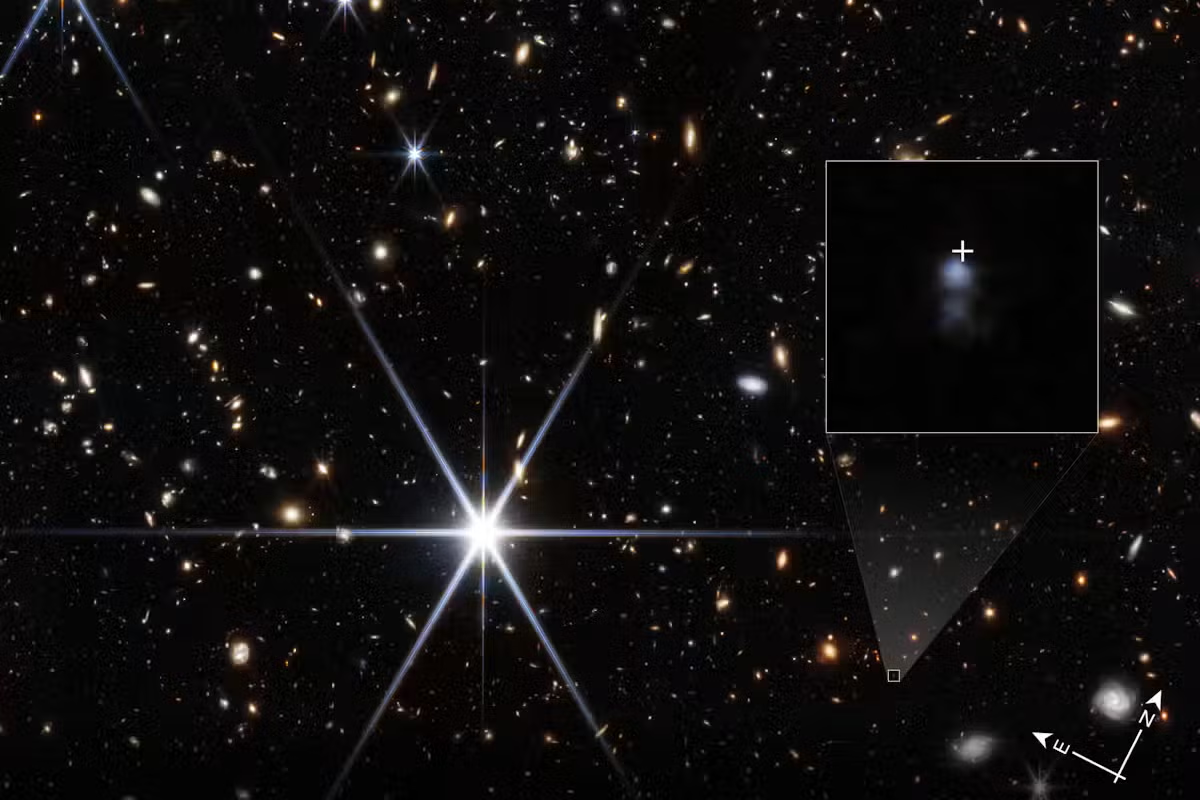
The James Webb Space Telescope has pinpointed the host galaxy of FRB 20240304B, the most distant fast radio burst ever confirmed, according to Mashable. The burst, a split‑second flash of radio waves, traveled more than 10 billion years before reaching Earth.
South Africa’s MeerKAT radio telescope first recorded the burst on 4 March 2024. After initial attempts with the world’s largest ground‑based telescopes failed to locate its origin, a team led by Manisha Caleb and Themiya Nanayakkara of the University of Sydney turned to JWST. Infrared imaging with JWST’s NIRCam revealed a faint galaxy that existed when the universe was roughly 3 billion years old – about 10.6 billion years ago – making it more than twice as distant as the previous record holder.
The identified galaxy is unusually small, with a mass roughly 1,000 times lower than typical fast‑radio‑burst hosts. It is also metal‑poor but actively forming stars, a contrast to the larger, more mature galaxies that usually produce such bursts. The findings were published in the journal Science, where Caleb noted, “We thought it would be a big, nicely formed galaxy with lots of stars, and instead it was a little dwarf galaxy, although it was actively forming stars.”
Fast radio bursts (FRBs) are millisecond‑long eruptions of radio energy whose origins remain largely mysterious. Since the first FRB was discovered in 2007, most have been observed only once, making them difficult to study. This new detection demonstrates that FRBs can serve as probes of the early universe, offering insight into star‑formation activity during the epoch known as “cosmic noon.”
Key facts
- FRB 20240304B was first detected by MeerKAT on 4 March 2024. (mashable.com)
- JWST identified the burst’s host galaxy as a dwarf galaxy existing 10.6 billion years ago. (mashable.com)
- The host galaxy has about 1,000 times less mass than typical FRB hosts and is actively forming stars. (mashable.com)
- The discovery was published in the journal Science. (mashable.com)
- Researchers leading the JWST analysis were Manisha Caleb and Themiya Nanayakkara of the University of Sydney. (mashable.com)
Sources
- [1] mashable.com — originally reported as “A starquake 10 billion years ago may have just sent a flash to Earth”