Brief
James Webb identifies host galaxy of 10‑billion‑year‑old fast radio burst
The burst was first caught by South Africa's MeerKAT telescope and later traced to a tiny, metal‑poor galaxy by JWST’s infrared camera.
By Felo News Desk · Published
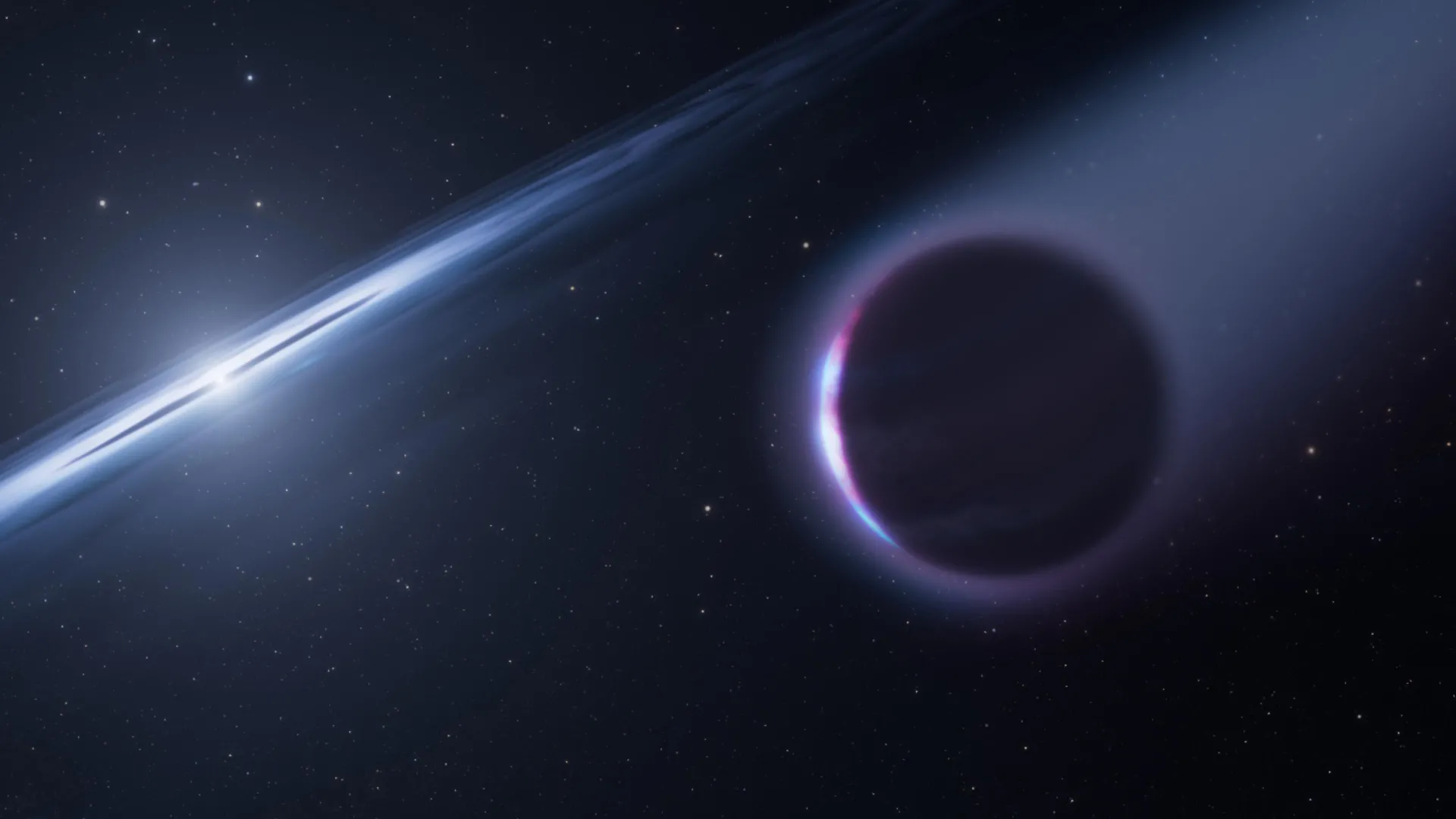
Researchers announced on 9 October that a fast radio burst detected on 4 March 2024, designated FRB 20240304B, originated in a galaxy seen when the universe was only one‑fifth of its current age. The discovery, published in *Science*, relied on data from South Africa’s MeerKAT radio telescope and follow‑up imaging by the James Webb Space Telescope (JWST).
What happened
MeerKAT, using the real‑time transient detection system MeerTRAP, recorded a millisecond‑long burst of radio waves that showed a large dispersion measure, indicating a great distance. Initial optical searches with ground‑based telescopes such as the Keck Observatory failed to reveal a host because the galaxy was too faint. JWST’s near‑infrared camera (NIRCam) later captured a tiny source at the burst’s sky position. Spectroscopic analysis of the galaxy’s light allowed scientists to calculate its redshift, confirming an age of about 10.6 billion years.
What the reports add
The Independent notes that the host galaxy is exceptionally small—about ten million solar masses, a fraction of the Milky Way’s mass—and appears to be a young, star‑forming system with very low metal content. This contrasts with most previously identified fast radio burst hosts, which are typically larger, more massive galaxies.
What was said
The article quotes the research team, stating that the dispersion of the burst’s frequencies “allows us to calculate how much material the signal has passed through – which in turn lets us calculate how far the signal has travelled.” The team also highlighted that the galaxy’s spectrum shows clear signatures of hydrogen and oxygen, confirming its youthful nature.
How it came about
Fast radio bursts have puzzled astronomers for nearly two decades since their discovery. Identifying a host galaxy at such a distance pushes the frontier of FRB research, showing that these energetic events occurred when the universe was only about 2 billion years old. The use of JWST’s infrared capabilities demonstrates how the telescope is expanding the reach of extragalactic astronomy, complementing radio facilities like MeerKAT.
Key facts
- FRB 20240304B was detected by MeerKAT’s MeerTRAP system on 4 March 2024. (independent.co.uk)
- JWST NIRCam imaging revealed a faint galaxy at the burst’s location. (independent.co.uk)
- Spectroscopy shows the host galaxy existed 10.6 billion years ago and has a mass of ~10 million solar masses. (independent.co.uk)
- The host galaxy is metal‑poor and actively forming stars, unlike most known FRB hosts. (independent.co.uk)
Sources
- [1] independent.co.uk — originally reported as “Scientists trace radio burst to a 10 billion-year-old distant galaxy”