Brief
Astronomers spot twin supermassive black holes in galaxy Mrk 501
Radio observations over 23 years revealed a second jet, indicating a hidden black‑hole companion that could merge within a century.
By Felo News Desk · Published
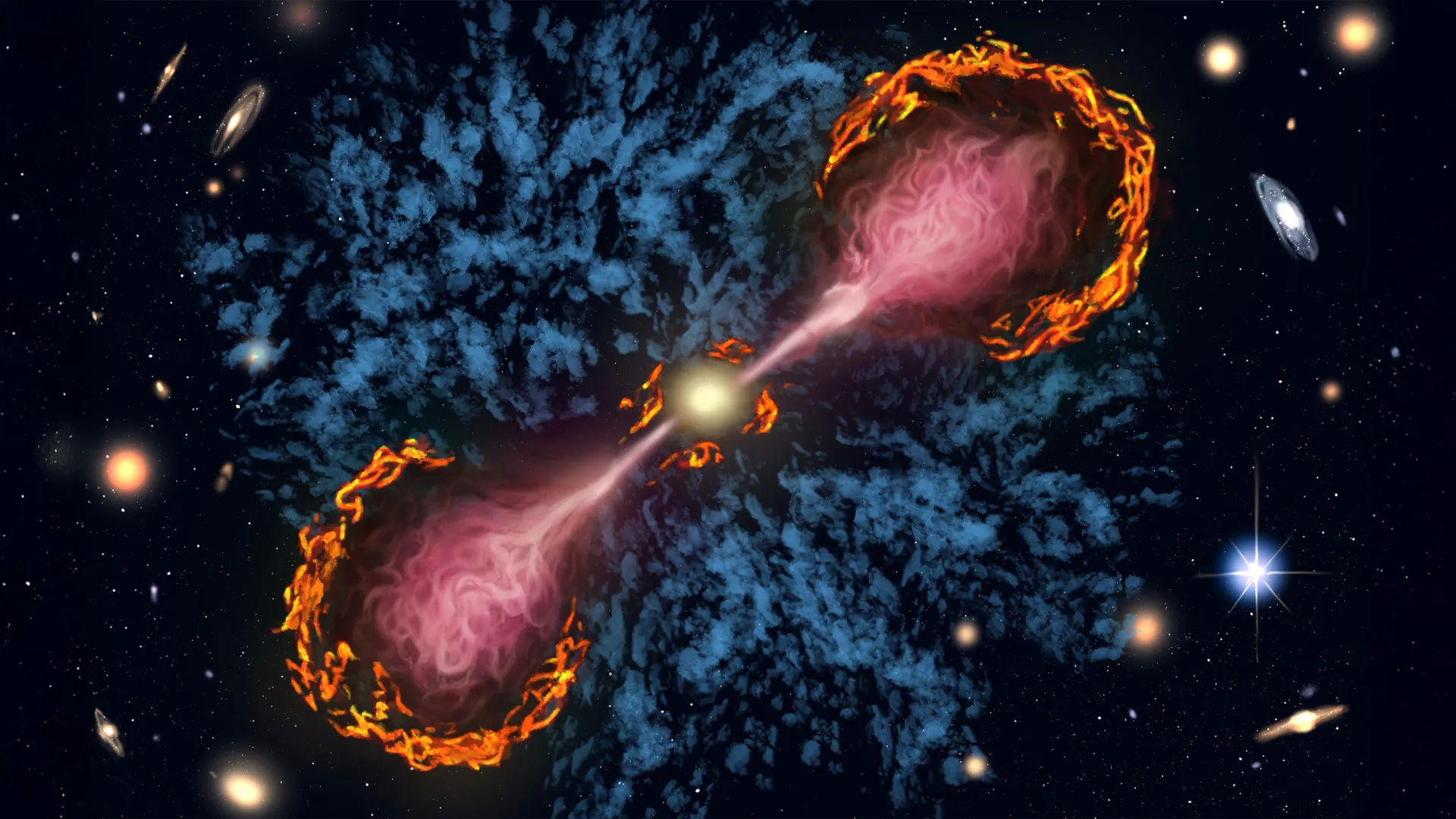
Scientists have found direct imaging evidence of a pair of supermassive black holes at the centre of the galaxy Mrk 501, according to a study led by Silke Britzen of the Max Planck Institute for Radio Astronomy (MPIfR) in Bonn. The discovery, based on radio data collected over roughly 23 years, shows a second jet of particles moving in a different direction from the well‑known jet that points toward Earth.
The research team analysed multi‑frequency radio observations taken on dozens of separate days. While the primary jet has long been visible because it is aimed at Earth, the newly identified jet was hidden until the extensive dataset allowed the scientists to track its motion. The two jets suggest the presence of two supermassive black holes orbiting each other, although the objects are too close together to be resolved individually.
Britzen said the finding was unexpected, noting that “we searched for it for so long, and then it came as a complete surprise that we could not only see a second jet, but even track its movement.” The study has been accepted for publication in the Monthly Notices of the Royal Astronomical Society and will appear in an upcoming issue.
Supermassive black holes, which can weigh millions to billions of times the Sun’s mass, are thought to grow by accreting gas and by merging with other black holes. Galaxy collisions are common, making black‑hole mergers a likely outcome, but direct observations of two such objects in close orbit have been elusive. The Mrk 501 system provides a rare glimpse of the intermediate stage before the two black holes spiral together, a process that could culminate in a merger within about 100 years.
The discovery adds to a growing body of work on black‑hole jets, including Felo News’ earlier coverage of how jets can influence galaxy evolution and the universal conditions that trigger jet formation.
Key facts
- The study was led by Silke Britzen of the Max Planck Institute for Radio Astronomy. (sciencedaily.com)
- Radio observations spanning roughly 23 years revealed a second jet in galaxy Mrk 501. (sciencedaily.com)
- The presence of two jets suggests a pair of supermassive black holes orbiting each other. (sciencedaily.com)
- The findings have been accepted for publication in Monthly Notices of the Royal Astronomical Society. (sciencedaily.com)
- The two black holes could merge within about 100 years, according to the researchers. (sciencedaily.com)
Sources
- [1] sciencedaily.com — originally reported as “Two monster black holes could collide in just 100 years”