Brief
Astronomers Identify Universal Trigger for Black‑Hole Jet Formation
A study led by Curtin University links jet activation to a common feeding‑rate threshold across black holes of vastly different masses.
By Felo News Desk · Published
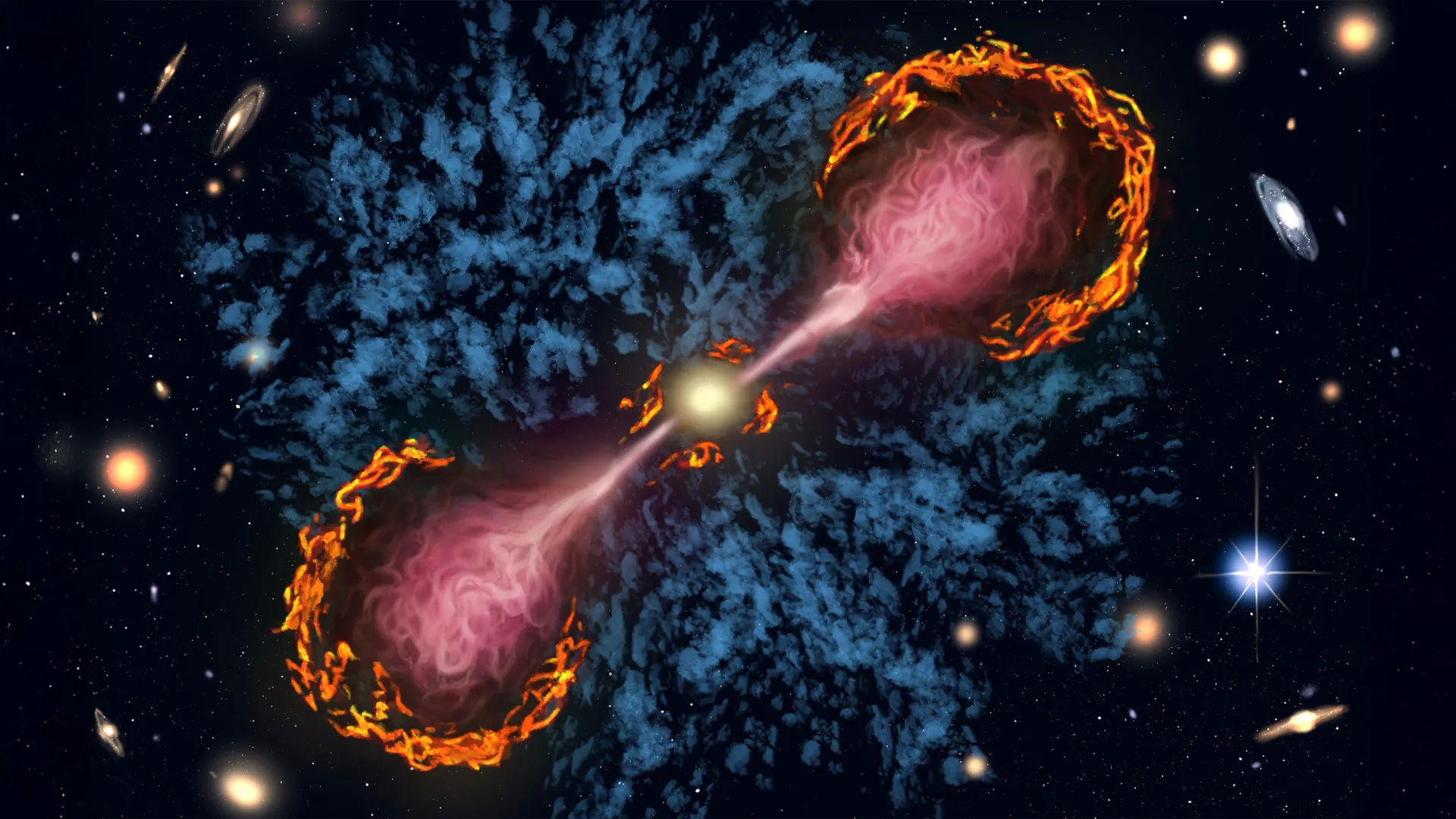
Scientists have uncovered a common condition that appears to switch on powerful jets from black holes of very different sizes, according to a study published in Nature Astronomy on Oct. 11, 2026.
What happened
The research team, headed by Dr. Adelle Goodwin of Curtin University’s International Centre of Radio Astronomy Research (ICRAR) and the Forrest Research Foundation, examined tidal disruption events—rare occasions when a star is torn apart by a supermassive black hole. By analysing the feeding rates of these black holes, the authors observed that jets are launched when the accretion rate falls to roughly two percent of the Eddington limit. This same threshold has previously been associated with jet formation in much smaller, stellar‑mass black holes within the Milky Way.
What the reports add
Goodwin’s team compared black holes that are about ten times the mass of the Sun with supermassive black holes weighing millions of solar masses. Despite the enormous mass disparity, both categories showed jet activation at the same feeding‑rate stage. The paper notes that this similarity suggests a fundamental, scale‑independent physics governing jet production.
What was said
"These black holes are separated by enormous differences in mass, but they appear to switch on their jets at the same point in the feeding process," Dr. Goodwin said to scitechdaily.com. She added, "That tells us something fundamental about black holes: the physics does not seem to care how big they are." Co‑author Dr. Andrew Mummery, based at the Institute for Advanced Study in Princeton, is also quoted in the article, though his specific remarks are not reproduced.
How it came about
The study builds on decades of speculation that black holes of all sizes might obey similar physical rules. Directly testing this idea with supermassive black holes has been challenging because changes in their feeding behavior can span thousands of years, far beyond the span of human observation. By focusing on tidal disruption events, which provide observable, short‑term changes in accretion, the researchers were able to capture the moment when the feeding rate crossed the critical 2 % threshold and jets emerged.
Key facts
- Jets from both stellar‑mass and supermassive black holes turn on when the feeding rate drops to about 2 % of the Eddington limit. (scitechdaily.com)
- The study was led by Dr. Adelle Goodwin of Curtin University’s ICRAR and the Forrest Research Foundation. (scitechdaily.com)
- Co‑author Dr. Andrew Mummery is affiliated with the Institute for Advanced Study in Princeton. (scitechdaily.com)
- The findings were published in Nature Astronomy on Oct. 11, 2026. (scitechdaily.com)
Sources
- [1] scitechdaily.com — originally reported as “Astronomers Discover a “Universal” Trigger for Black Hole Jets”