Brief
Stretching CsV3Sb5 crystal reveals two hidden superconducting states
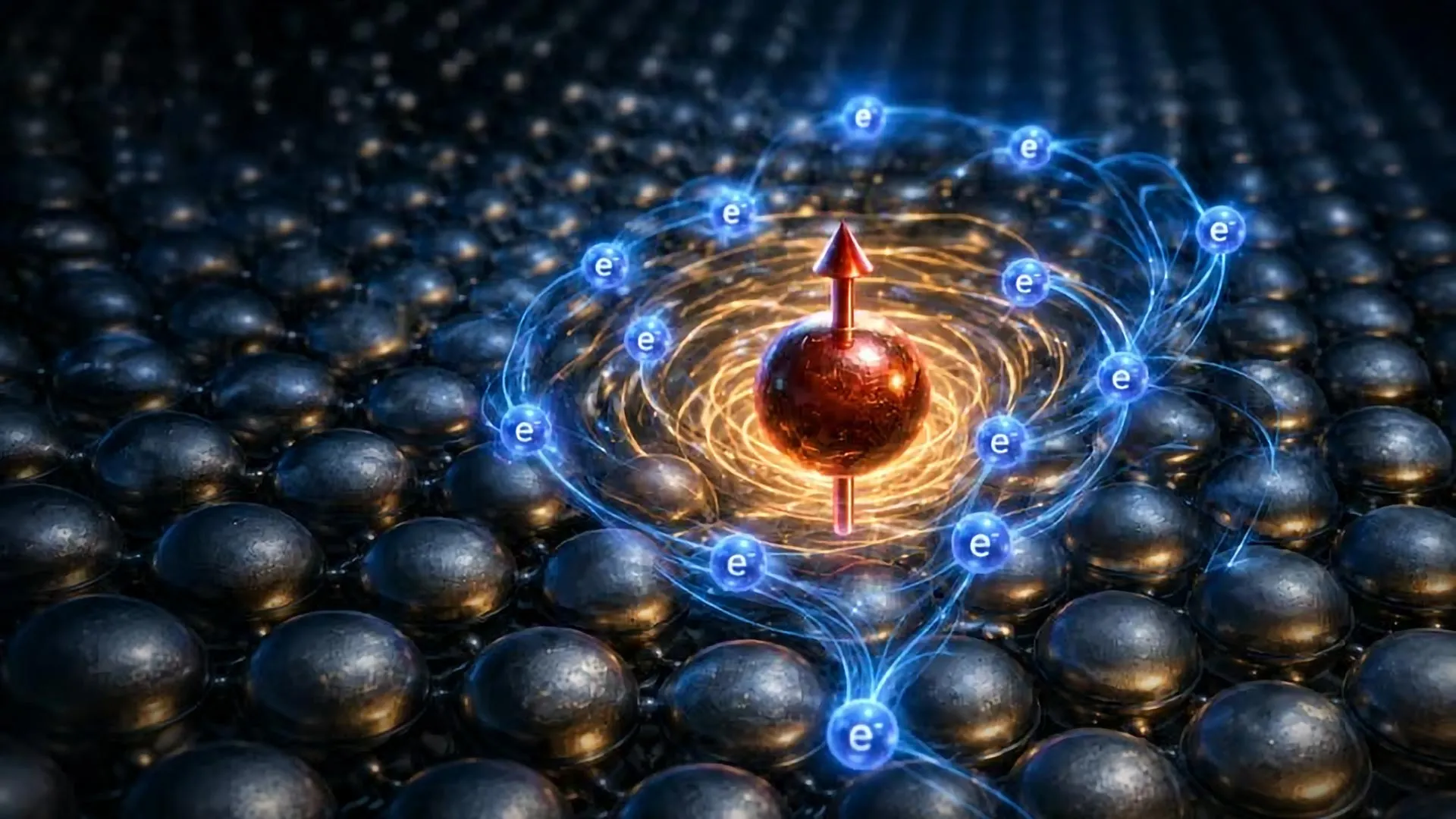
Researchers at Okayama University used a piezoelectric strain cell to stretch CsV3Sb5, uncovering two hidden superconducting states and a higher critical temperature.
By Felo News Desk · Published
Scientists at Okayama University in Japan applied controlled mechanical strain to the kagome metal CsV3Sb5 and observed two distinct, previously hidden superconducting states, according to a report on SciTechDaily published on 11 October 2026.
What happened
The team stretched high‑quality CsV3Sb5 crystals by less than 1% along a single crystallographic direction using a custom‑built piezoelectric strain cell. While monitoring the material’s superconducting transition with nuclear quadrupole resonance, they found that the strain separated two superconducting phases that had been indistinguishable in earlier experiments. The strain also increased the temperature at which superconductivity onsets, without markedly altering the material’s charge‑density‑wave order that appears near 94 K.
What the reports add
SciTechDaily notes that the experiment clarifies long‑standing contradictions in prior measurements of the superconducting gap in CsV3Sb5, where some studies reported a fully open gap and others suggested nodal behavior. By decoupling superconductivity from the charge ordering, the new data provide a clearer view of the pairing mechanism.
What was said
Associate Professor Shinji Kawasaki and Professor Guo‑qing Zheng, who led the study, are quoted in the article as explaining that “controlling strain along a single direction allows us to investigate superconductivity independently of the charge ordering that normally complicates its behavior.”
How it came about
CsV3Sb5 belongs to a family of kagome metals whose triangular atomic lattice can host competing quantum orders, including charge density waves and superconductivity. Earlier Felo News coverage linked to related breakthroughs in superconductivity, such as ultrafast picosecond pulses pushing materials to their depairing limit (picosecond‑pulses‑superconductors‑breaking‑point) and theoretical advances predicting Kondo effects in real materials (kondo‑effect‑prediction‑caltech‑yale). The new strain‑tuning approach adds a mechanical dimension to these ongoing efforts to understand and control unconventional superconductors.
Key facts
- Less than 1% uniaxial strain was applied to CsV3Sb5 crystals. (scitechdaily.com)
- Two distinct superconducting states emerged under strain. (scitechdaily.com)
- The superconducting transition temperature increased with strain. (scitechdaily.com)
- The experiment used a custom piezoelectric strain cell and nuclear quadrupole resonance measurements. (scitechdaily.com)
- Researchers were Associate Professor Shinji Kawasaki and Professor Guo‑qing Zheng of Okayama University. (scitechdaily.com)
Sources
- [1] scitechdaily.com — originally reported as “Researchers Stretch a Quantum Material and Uncover Two Hidden Superconducting States”