Brief
NASA’s INSPYRE Campaign studies fire‑generated pyrocumulonimbus clouds
The INSPYRE experiment used aircraft and ground sensors to probe the massive pyrocumulonimbus cloud formed by Idaho’s Wildhorse grass fire.
By Felo News Desk · Published
The Wildhorse grass fire in eastern Idaho produced a towering pyrocumulonimbus cloud, prompting NASA’s INSPYRE (Injected Smoke and PYRocumulonimbus Experiment) campaign to conduct a six‑week flight series this summer.
What happened
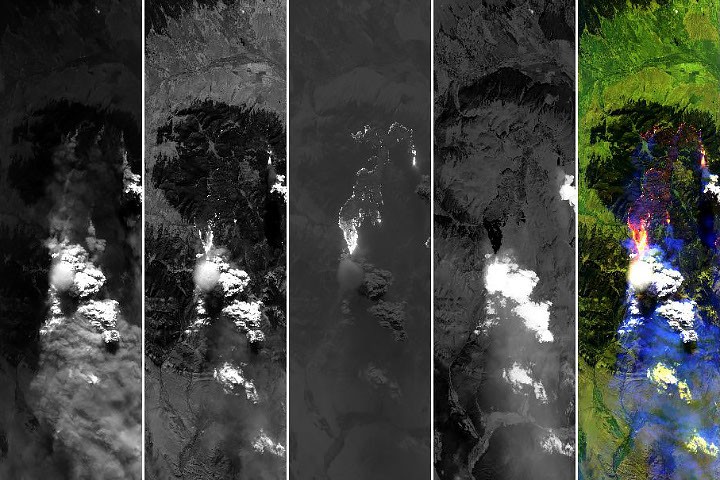
During the fire, a pulse of smoke rose to 30,000‑50,000 feet, creating a pyrocumulonimbus (pyroCb) cloud that can generate lightning, rain and strong winds. NASA deployed a Gulfstream jet from the National Center for Atmospheric Research (NCAR) near Boulder, Colorado, and a high‑altitude ER‑2 aircraft equipped with 14 instruments. The Gulfstream crew sampled smoke particles, gases, ice crystals and radiation while flying through, above and below the cloud. The ER‑2 tracked fire intensity, updraft speeds, smoke and cloud properties from above. Ground teams drove sensor‑laden trucks to observe the same events from the fire line.
What the reports add
NASA’s description emphasizes that pyroCb clouds can lift smoke into the stratosphere, where it may travel across continents and persist longer than lower‑altitude smoke. The agency notes that such clouds have been observed only since the early 2000s, when satellite data first showed smoke reaching volcanic‑like altitudes. Researchers stress that understanding the formation mechanisms—whether driven by fire energetics, intensity or upper‑atmospheric conditions—remains a key knowledge gap.
What was said
Olga Kalashnikova, a researcher at NASA’s Jet Propulsion Laboratory in Southern California and a principal investigator on INSPYRE, said, “We still do not understand if they’re driven by fire energetics, or fire intensity, or by atmospheric conditions above.” Neil Lareau, deputy project investigator for INSPYRE, added, “A unique thing about pyrocumulonimbus is they are fire‑generated weather, meaning the fire makes its own weather.”
How it came about
The INSPYRE campaign is the first aircraft program designed specifically to study pyroCb clouds. It builds on earlier NASA observations of rare pileus clouds over Montana wildfires, documented in a September 29 Felo News article. By combining airborne measurements with ground sensors, the team aims to determine how wildfire‑generated clouds transport smoke upward, how particles and gases transform within the cloud, and what proportion reaches the stratosphere. Findings are expected to improve firefighter safety by predicting when pyroCbs are likely to develop and how they influence fire behavior on the ground.
Key facts
- The Wildhorse grass fire in eastern Idaho generated a pyrocumulonimbus cloud rising 30,000‑50,000 feet. (nasa.gov)
- NASA’s INSPYRE campaign used a Gulfstream jet and an ER‑2 aircraft for six weeks of flights in summer 2026. (nasa.gov)
- Olga Kalashnikova of JPL said scientists still do not know what primarily drives pyroCb formation. (nasa.gov)
- Neil Lareau described pyrocumulonimbus clouds as fire‑generated weather that can affect fire conditions on the ground. (nasa.gov)
- Ground teams operated sensor‑equipped trucks to complement airborne observations of the cloud. (nasa.gov)
Sources
- [1] nasa.gov — originally reported as “NASA Campaign Explores Clouds Spawned by Wildfires”