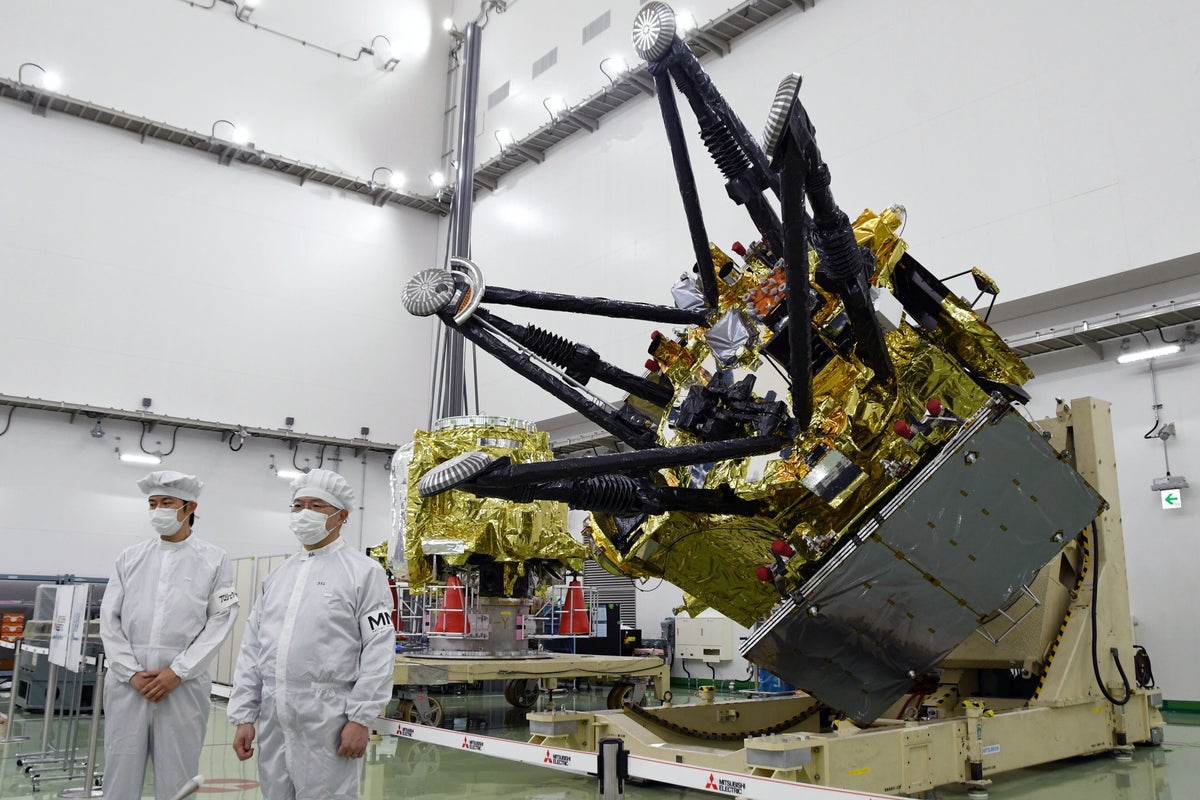
Japan launches MMX mission to Mars’ moon Phobos on H3 rocket
The Martian Moons eXploration mission lifted off at 3:41 p.m. ET, aiming to collect and return Phobos samples.
By Felo News Desk · Published
Japan’s Martian Moons eXploration (MMX) spacecraft launched from Tanegashima Space Center on Oct. 19, 2026, at 3:41 p.m. ET (1941 GMT), according to space.com, scientificamerican.com and cnet.com.
What happened
The H3 launch vehicle lifted off from Pad‑2 of the Yoshinobu Launch Complex at Tanegashima, climbing a nominal trajectory over the Pacific Ocean. The 207‑foot‑tall (63 m) rocket, jointly developed by JAXA and Mitsubishi Heavy Industries, carried the MMX spacecraft toward Mars orbit, where it will study Phobos and Deimos before attempting a sample‑return from Phobos.
- The flight was the 10th liftoff of Japan’s expendable, two‑stage H3 rocket.
- Four solid‑rocket boosters were jettisoned in pairs just before the two‑minute mark of the ascent.
- The payload fairing separated about 1 minute 20 seconds after liftoff, exposing the spacecraft to vacuum.
- H3’s first stage, powered by two LE‑9 engines, produced a combined thrust of 331,000 lb (1,471 kN).
- At T+5 minutes the main‑engine‑cut‑off occurred, and the second stage ignited for a 5.5‑minute burn.
- A trans‑Mars injection burn is scheduled about one hour and four minutes after liftoff, lasting roughly 6 minutes 25 seconds; the spacecraft will separate about one minute after that burn.
What the reports add
Space.com detailed the launch sequence and vehicle performance, noting the booster jettison, fairing separation, engine thrust and the planned trans‑Mars injection burn. Scientific American emphasized the international partnership, naming NASA, the French space agency CNES and the European Space Agency as contributors of equipment and communications support. It also quoted ESA MMX Project Scientist Elliot Sefton‑Nash, who said:
“Bringing samples to our most sophisticated labs here on Earth is a multiplier for discoveries, because our most precise instruments are too large, complex or sensitive to send to space.”
CNET reported that the mission will include a rover named IDEFIX, which will first sample subsurface material on Phobos before the main spacecraft lands in 2030 and returns at least 10 grams of material to Earth in 2031.
What was said
“The samples from MMX will bring forth paradigm‑shifting science on the Mars system for generations to come, especially as NASA prepares to send the first humans to Mars,” Nicky Fox, associate administrator for NASA’s Science Mission Directorate, told CNET.
“Having the answer will help illuminate that early era when Earth and the other inner planets may have been acquiring much of their water and organic compounds,” Tom Statler, MMX program executive and program scientist at NASA Headquarters, said in the announcement.
How it came about
Felo News previously covered the mission’s preparation on Oct. 18, noting project manager Yasuhiro Kawakatsu’s remarks that the Martian moons are “the most important unclimbed mountains in the solar system.” The launch follows years of development of the H3 launcher and collaborative agreements with NASA, CNES and ESA, positioning MMX as the first spacecraft to land on and return material from Phobos. Live streams set up by JAXA allowed the public to watch the historic launch in real time.
Key facts
- MMX launched from Tanegashima Space Center on Oct. 19, 2026 at 3:41 p.m. ET (space.com)
- The launch vehicle was a two‑stage H3 rocket, the 10th flight of this type (space.com)
- The mission is a JAXA‑led partnership with NASA, CNES and ESA (scientificamerican.com)
- NASA’s Nicky Fox said the samples will enable paradigm‑shifting science (cnet.com)
Sources
- [1] space.com
- [2] scientificamerican.com
- [3] cnet.com