NASA says Super El Niño is turning the Pacific ocean blue
Satellite images reveal a marked shift from green to blue in the equatorial Pacific as the 2026 Super El Niño disrupts nutrient upwelling.
By Felo News Desk · Published
NASA’s satellite network reports that the equatorial Pacific has become noticeably bluer over recent months, a change linked to the ongoing Super El Niño, according to two UK outlets.
What happened
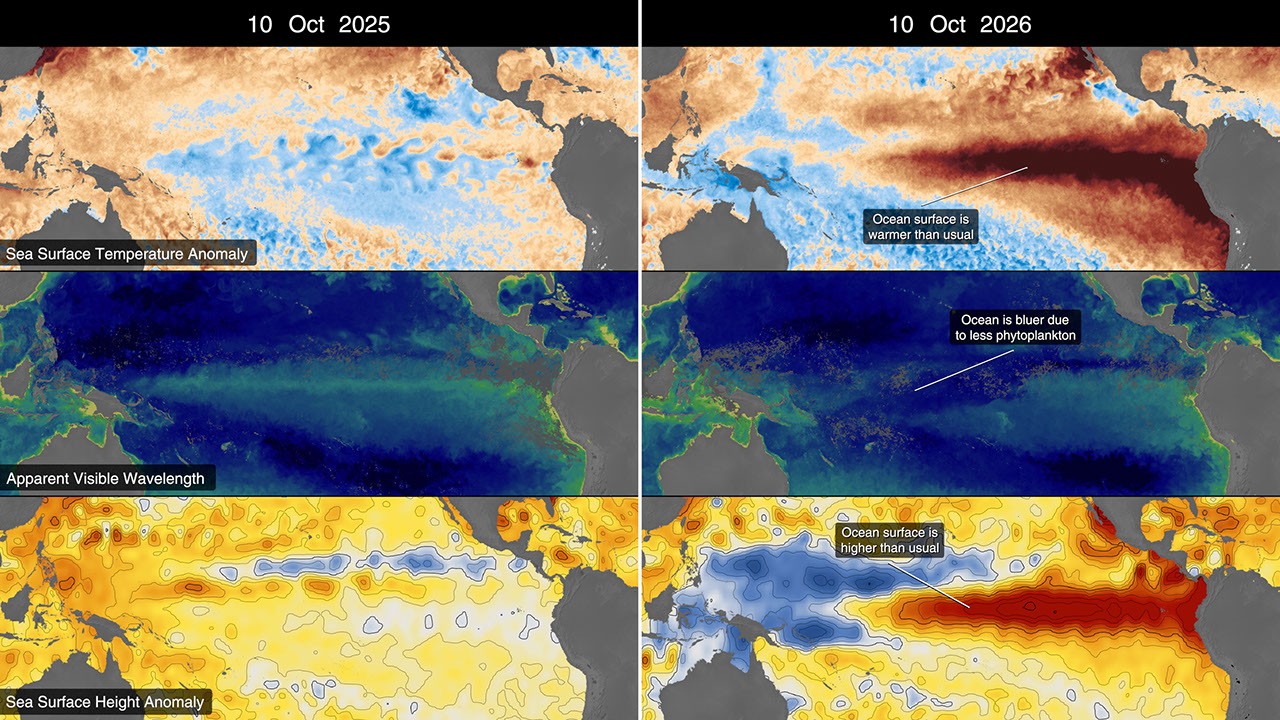
Timelapse imagery from NASA shows a green‑coloured band along the equator shrinking as a bright blue front advances. Side‑by‑side comparisons with data from 2025 illustrate that the same region retained its typical green hue throughout that year. The shift coincides with rising sea‑surface temperatures that accompany the Super El Niño.
What the reports add
- The Daily Mail describes the ocean as “measurably more blue” and links the colour shift to the loss of photosynthesising plankton that normally give the water an emerald tint.
- The Independent explains that the blue hue results from phytoplankton dying off, removing the green chlorophyll pigment that reflects green light back to space.
- Both outlets note that weakened upwelling of cold, nutrient‑rich water is the driver of the plankton decline.
- NASA’s PACE satellite, launched in 2024, is providing the first real‑time hyperspectral colour data for this El Niño, allowing scientists to track the change as it happens.
- NASA measurements indicate sea‑surface temperatures in the eastern Pacific are about 1.7 °C (3 °F) above the long‑term average, with the potential for a further rise.
- NOAA estimates an 83 % probability that this is the strongest El Niño since records began in 1950.
- Kelvin waves observed early in 2026 have pushed warm water eastward, raising sea levels along the South American coast by up to 1.3 feet.
What was said
"Some people think of water as being just blue, but it's amazing the multitude of colours the ocean can be," said Matthew Kehrli, lead research scientist on the PACE team at NASA’s Goddard Space Flight Center.
"Kelvin waves are like the heartbeat of El Niño," explained Josh Willis, project scientist for sea‑level missions at NASA’s Jet Propulsion Laboratory.
How it came about
Earlier this month Felo News reported that the 2026 El Niño is projected to set heat records (Super El Niño projected to hit record heat) and that NASA is tracking unprecedented ocean warming (NASA tracks historic 2026 El Niño). Those pieces outlined the broader climate context that now manifests as a visible colour shift in the Pacific.
Key facts
- NASA satellite data show the equatorial Pacific has become measurably bluer in recent months. (dailymail.co.uk)
- The colour shift is linked to a decline in photosynthesising plankton caused by disrupted upwelling. (independent.co.uk)
- Side‑by‑side satellite images compare the 2025 green hue with the 2026 blue hue. (dailymail.co.uk)
Sources
- [1] dailymail.co.uk
- [2] independent.co.uk