Brief
Antarctic sea ice reaches third‑lowest winter maximum on record in 2026
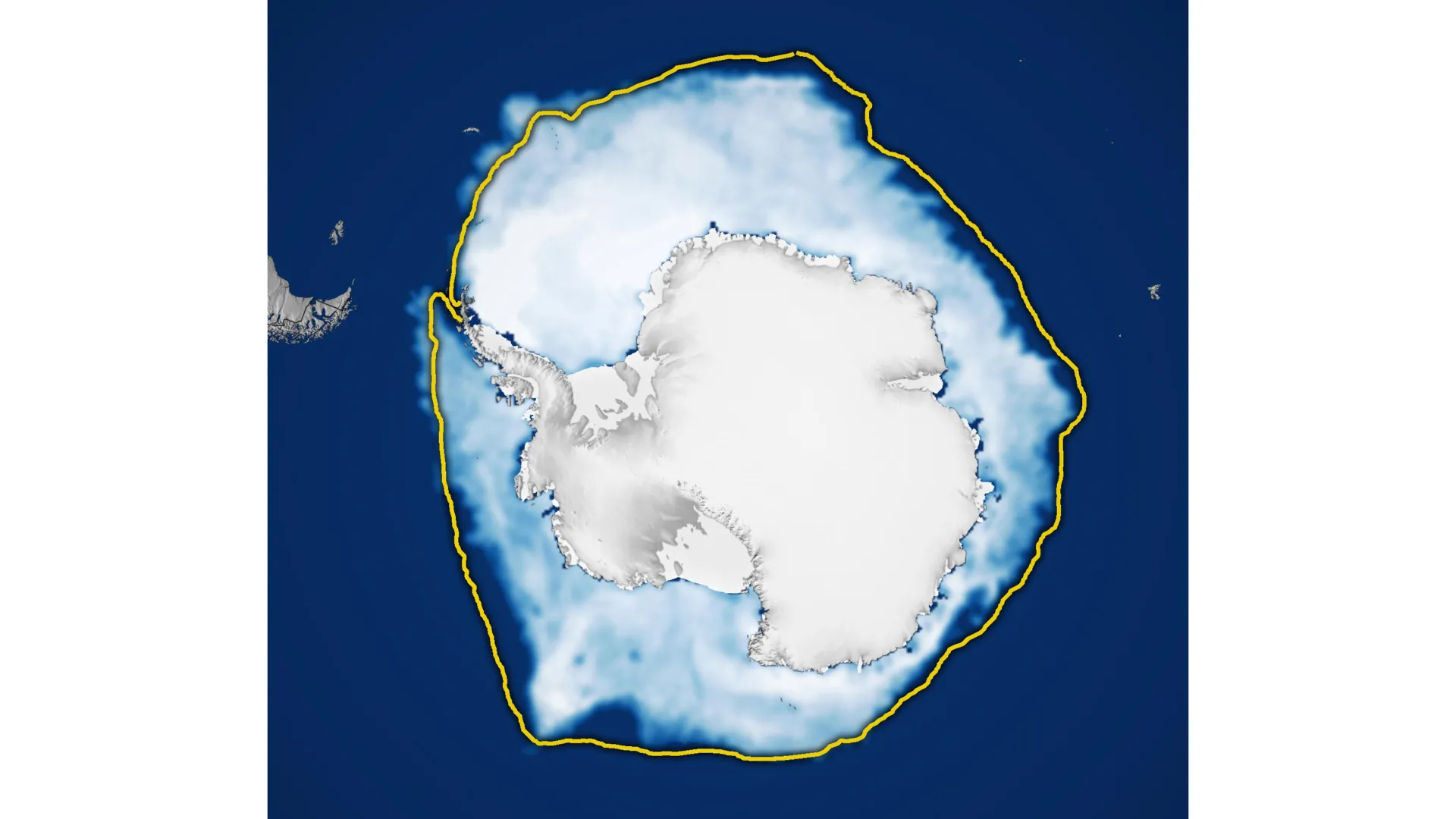
The continent's ice cover shrank to 17.59 million sq km on 14 September, marking a sharp reversal from earlier growth trends.
By Felo News Desk · Published
NASA and the National Snow and Ice Data Center (NSIDC) reported that Antarctica's sea‑ice extent peaked at about 17.59 million square kilometres on 14 September 2026, the third‑lowest winter maximum since satellite records began in the late 1970s.
What happened
The annual maximum, normally reached in September, fell well below the long‑term average. The 2026 figure ranks behind only the 2023 and 2022 winter peaks, both of which were also unusually low. The decline follows a shift that began in 2015, when Antarctic sea‑ice growth halted after decades of modest expansion.
What the report adds
Scitechdaily notes that between 1979 and 2014 the continent's ice extent grew by roughly 1 percent per decade, a trend that contrasted with the Arctic's rapid loss. The article highlights that the growth period included record‑setting winters in 2012‑2014, while the Arctic was experiencing steep declines. After 2014, the data show a consistent downward trajectory, with occasional short‑term recoveries that never returned to the earlier highs.
What was said
NASA and NSIDC are quoted in the Scitechdaily piece as the sources of the satellite measurements, but no direct statements are provided.
How it came about
Felo News previously covered the same winter maximum in its October 16 article, which also cited NASA and NSIDC figures. The earlier report emphasized the broader reversal from a multi‑decade growth phase that began in the late 1970s.
Key facts
- Antarctic sea ice peaked at 17.59 million sq km on 14 September 2026. (scitechdaily.com)
- The 2026 peak is the third‑lowest winter maximum since satellite monitoring began. (scitechdaily.com)
- NASA and NSIDC provided the satellite measurements. (scitechdaily.com)
- Antarctic sea‑ice growth stopped in 2015 after a 1 percent per decade increase from 1979‑2014. (scitechdaily.com)
- The most extreme low values occurred in 2023, with both the summer minimum and winter maximum at record lows. (scitechdaily.com)
Timeline
- 1979-01-01 — Satellite monitoring of Antarctic sea ice began.
- 2014-12-31 — End of multi‑decade growth period for Antarctic sea ice.
- 2026-09-14 — Antarctic sea ice reaches 17.59 million sq km, third‑lowest winter maximum.
Sources
- [1] scitechdaily.com — originally reported as “Antarctica’s Sea Ice Has Gone From Record Highs to Near-Record Lows”