Brief
Scientists turn melted Antarctic holes into neutrino observatories
IceCube has lowered detector strings into refrozen lakes in about 100 holes near the South Pole, enabling new cosmic neutrino observations.
By Felo News Desk · Published
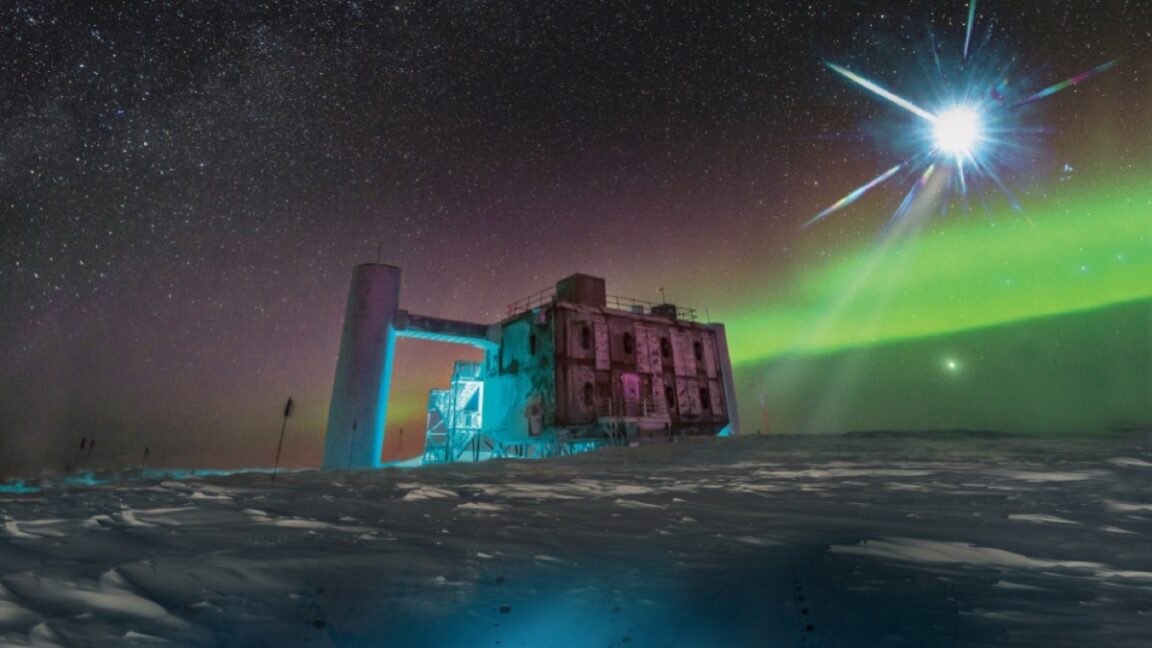
NASA’s Astronomy Picture of the Day notes that nearly 100 holes melted near the South Pole are now serving as an astronomical observatory for the IceCube Neutrino Observatory.
Scientists lowered long strings, each fitted with basketball‑sized light detectors, into the vertical lakes; the water quickly refroze, embedding the sensors in clear ice. The detectors capture blue light produced when high‑energy neutrinos from distant cosmic events collide with ice molecules, generating fast secondary particles.
IceCube has already recorded many such neutrino events. A 2010 photograph shows one of the last detector strings being lowered, underscoring IceCube’s status as the largest neutrino detector ever built. Earlier this week, a founding leader of the IceCube Collaboration was announced as a Nobel Prize in Physics laureate.
Key facts
- About 100 melt‑created holes near the South Pole are used by IceCube as observatories. (nasa.gov)
- IceCube strings carry basketball‑sized light detectors that sense blue light from neutrino interactions. (nasa.gov)
- The observatory has already detected numerous high‑energy cosmic neutrinos. (nasa.gov)
- A founding leader of the IceCube Collaboration was announced as a Nobel Prize in Physics recipient. (nasa.gov)
Sources
- [1] nasa.gov — originally reported as “APOD: 2026 October 11 - Ice Fishing for Cosmic Neutrinos”