Brief
SpaceX launches NASA’s 35th cargo mission to ISS with new experiments
The Falcon 9‑launched Dragon carried over 6,300 lb of supplies, solar arrays and cutting‑edge research to the orbiting laboratory.
By Felo News Desk · Published
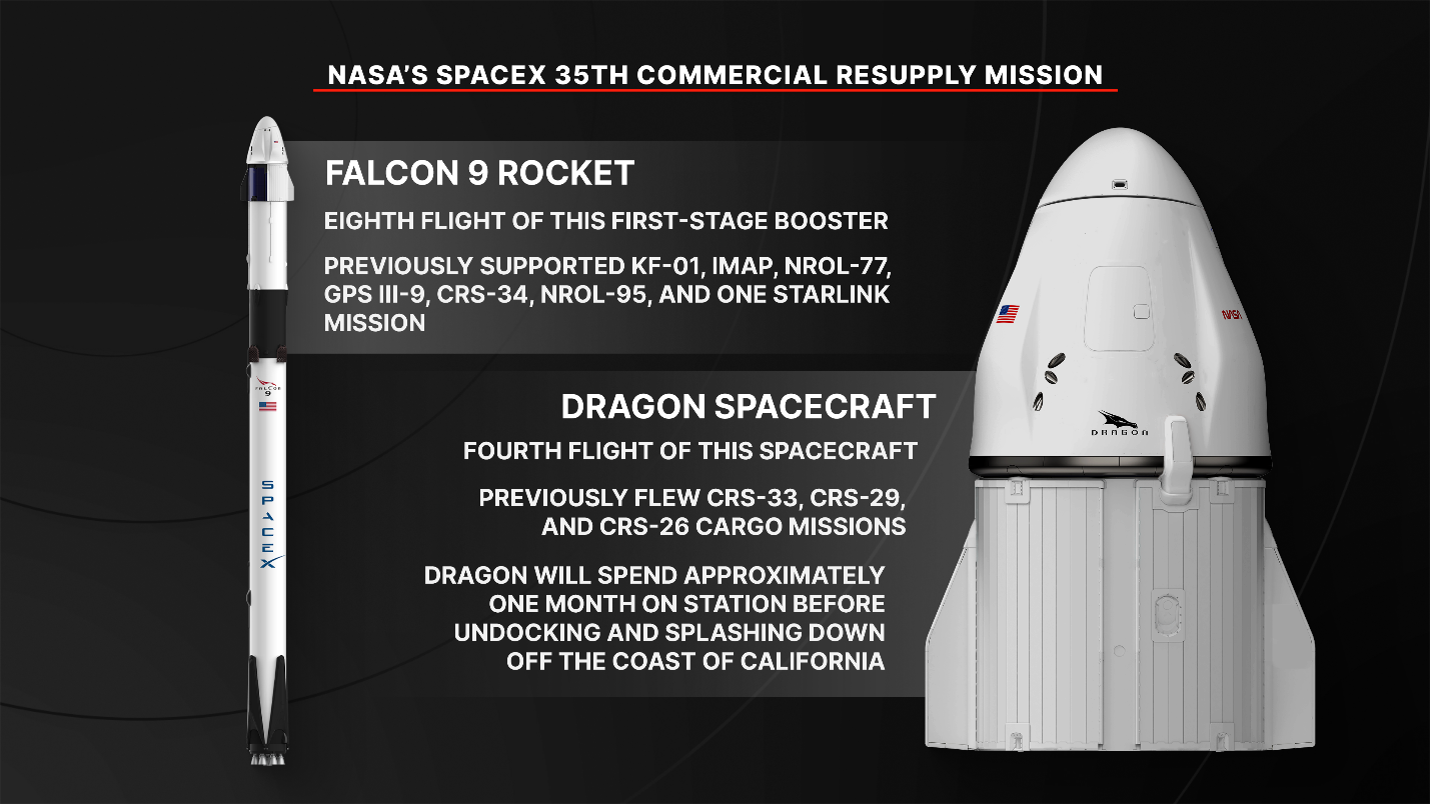
NASA’s 35th commercial resupply mission lifted off at 6:33 a.m. EDT on Tuesday, Oct. 13, from Space Launch Complex 40 at Cape Canaveral Space Force Station aboard a SpaceX Falcon 9, according to NASA.
The Dragon spacecraft is transporting more than 6,300 pounds of supplies, including the final pair of Roll‑Out Solar Arrays that will complete the station’s power‑system augmentation, and a suite of scientific experiments. Among the payload are hardware to manufacture artificial retinas in microgravity, 3‑D heart‑tissue models for drug testing, a study of glass formation in space, and brain organoids aimed at neurodegenerative‑disease research.
Dragon is slated to autonomously dock with the space‑facing port of the Harmony module at about 11 a.m. EDT on Thursday, Oct. 15. NASA will stream the rendezvous and docking from 9:15 a.m. EDT on its website. The spacecraft will remain attached to the station until mid‑November, when it will depart with time‑critical research and cargo and splash down off the California coast.
These investigations support NASA’s broader goals, including the Artemis program and future deep‑space missions, by providing data that benefit Earth‑based research and lay groundwork for human exploration of the Moon and Mars.
Key facts
- Launch time was 6:33 a.m. EDT on Oct. 13, 2026 (nasa.gov)
- Dragon carries over 6,300 pounds of cargo, including final Roll‑Out Solar Arrays (nasa.gov)
- Docking is scheduled for around 11 a.m. EDT on Oct. 15, 2026 (nasa.gov)
- Experiments include artificial retina hardware, 3‑D heart tissue models, glass formation study, and brain organoids (nasa.gov)
- Dragon will return to Earth in mid‑November, splashing down off California (nasa.gov)
Sources
- [1] nasa.gov — originally reported as “NASA Science, Cargo Launch on 35th SpaceX Resupply Mission to Station”