Brief
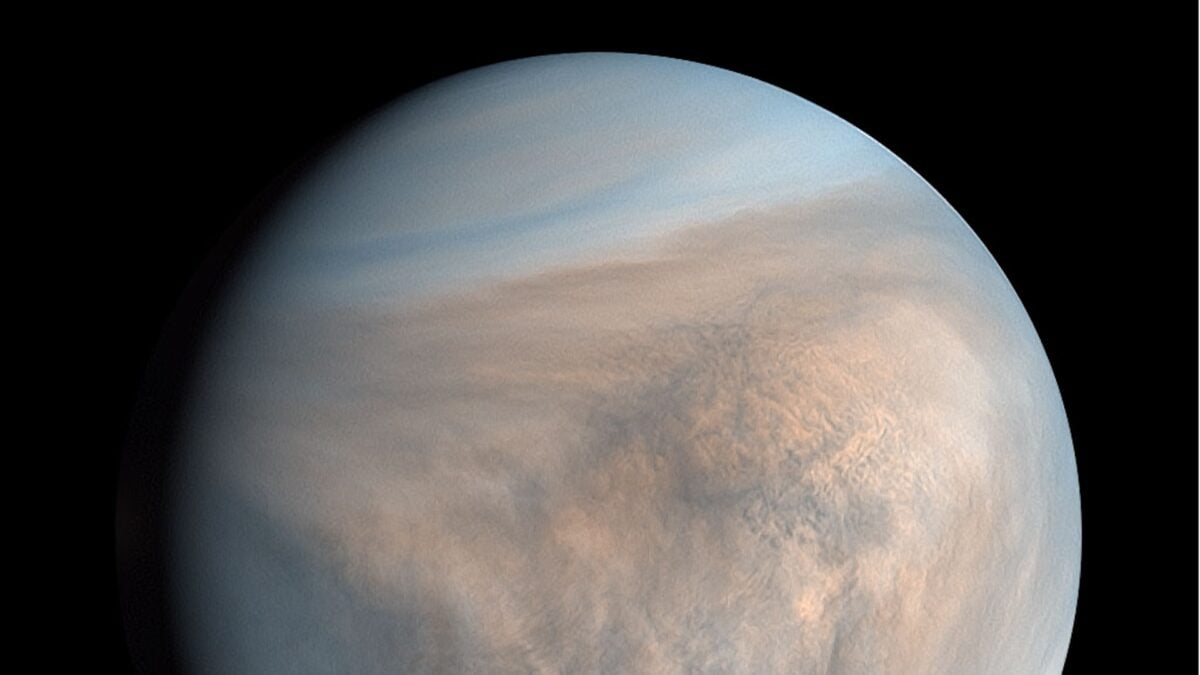
Cosmic dust identified as source of Venus' lower atmospheric haze
A microphysical model links a steady influx of meteoritic dust to the yellowish haze observed by 1970s probes.
By Felo News Desk · Published
Planetary scientist Hiroki Karyu and his team at Tohoku University in Sendai, Japan, have shown that the persistent lower haze on Venus originates from cosmic dust particles delivered by meteoroids, according to a study published in Nature Astronomy.
What happened
The research used a microphysical simulation to track how tiny dust grains from burning meteors interact with the planet’s thick sulfuric‑acid clouds. The model demonstrates that the continuous influx of these particles is sufficient to sustain the observed haze layer, matching the particle‑size distribution recorded by the Venera and Pioneer Venus probes in the 1970s.
What the reports add
Ars Technica notes that earlier hypotheses favored volcanic ash or surface dust as the haze source. The new study argues that even large volcanic or surface‑dust influxes would not produce the required chemical interactions with sulfuric acid. Instead, the dust acts as condensation nuclei, similar to how aerosols seed clouds on Earth, promoting cloud formation throughout the main cloud deck.
What was said
“The continuous influx of cosmic dust is sufficient to sustain this lower haze layer with the particle size distribution observed by the entry probes,” the authors wrote in Nature Astronomy.
Ars Technica also quoted Karyu: “These haze particles of cosmic origin act as efficient condensation nuclei, promoting cloud formation in the main cloud deck even far from their initial source.”
How it came about
Venus’ lower haze was first detected by Soviet Venera landers and NASA’s Pioneer Venus missions in the 1970s, but its composition remained unclear for decades. Recent advances in microphysical modeling allowed Karyu’s team to simulate the complex chemistry of sulfuric‑acid clouds and assess the role of external dust. Their findings overturn the long‑standing volcanic‑ash theory and align with earlier observations of meteoritic dust influx on other planetary bodies.
Key facts
- Venus' lower atmospheric haze is formed by cosmic dust particles from meteoroids. (arstechnica.com)
- The dust acts as condensation nuclei, enabling cloud formation in sulfuric‑acid clouds. (arstechnica.com)
- Microphysical modeling shows the dust influx matches the particle‑size distribution recorded by 1970s probes. (arstechnica.com)
- Volcanic ash and surface dust were ruled out as primary haze sources. (arstechnica.com)
Sources
- [1] arstechnica.com — originally reported as “Venus' mysterious haze is actually cosmic dust”